

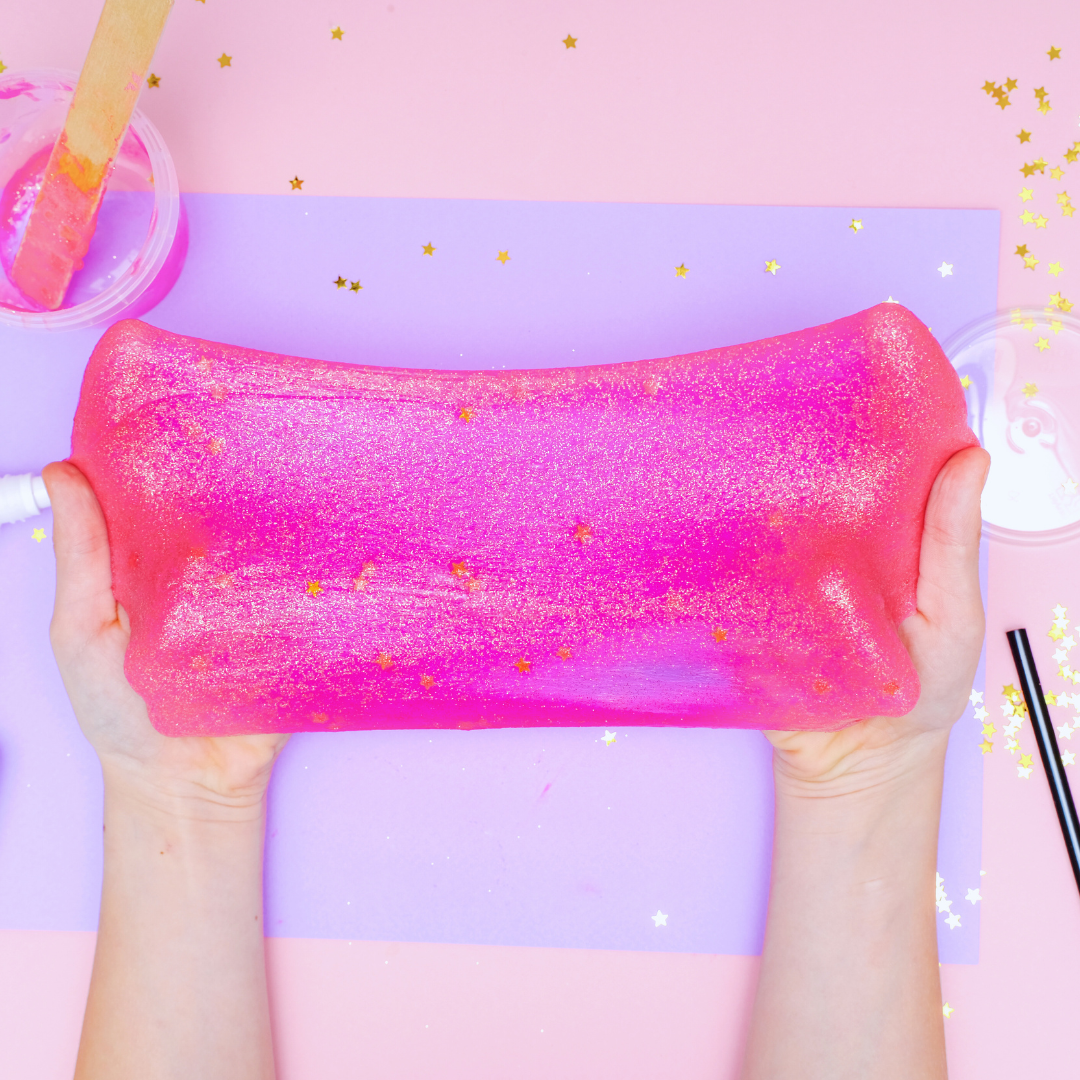




Slime is often seen as just a fun, gooey toy, but homemade slime is more than that—it’s a practical example of chemistry in action. When someone mixes ingredients like glue, water, and borax, they are creating chemical bonds that change the properties of the material. This transformation from liquid to a stretchy solid demonstrates key concepts in chemistry, such as polymers and cross-linking.
Making homemade slime allows learners to observe how molecules behave and interact, providing a hands-on experience with these scientific principles. The process highlights how substances can change state and structure without needing complex lab equipment or advanced knowledge.
By exploring the science behind slime, people can better understand everyday materials and reactions. This simple activity reveals important lessons about chemical reactions, materials science, and the behaviour of polymers in a way that is both accessible and engaging.
Chemistry at the Heart of Homemade Slime
Homemade slime relies on chemical principles that govern how certain molecules interact and change state. These interactions explain the unique stretchy, gel-like properties of slime. The process involves polymers, their structure, and how specific ingredients trigger transformations in those polymers.
Understanding Polymers and Polymer Chains
Polymers are long chains of repeated molecules called monomers. In slime, the base polymer is polyvinyl acetate (PVA), found in most school glue. These PVA molecules are flexible but separate, allowing the glue to flow easily.
When slime is made, these polymer chains are encouraged to link together, which changes their behaviour. Unlike liquid glue, the linked polymer chains in slime create a substance that is both sticky and elastic. The length and amount of these chains directly affect the slime’s texture and stretchiness.
The Role of Crosslinking in Slime Formation
Crosslinking occurs when polymer chains connect at various points, forming a network. This network restricts the chains’ movement but still allows some flexibility, creating the slime’s semi-solid form.
In slime chemistry, crosslinking changes the PVA glue from a liquid to a more solid gel. The activation happens through a chemical reaction where slime activators introduce molecules that link polymer chains together. These crosslinks resist flow, giving slime its unique consistency.
Essential Ingredients: School Glue, Slime Activators, and Borax
Most slime recipes start with school glue, which contains PVA. This glue provides the polymer chains vital for slime’s base structure.
Slime activators, often solutions containing sodium borate (borax), boric acid, or similar compounds, cause crosslinking by bonding with PVA chains. Borax dissociates in water to form borate ions, which connect polymer chains, solidifying the slime.
Key components:
|
Ingredient |
Role |
|
School glue (PVA) |
Polymer source |
|
Sodium borate |
Crosslinking agent |
|
Boric acid |
Alternative crosslinker |
These ingredients interact precisely to create the slime’s characteristic texture and behaviour.
The Science Behind Making Slime at Home
Making slime involves precise ingredients and chemical interactions that transform separate substances into a stretchy, flexible material. Understanding what each component does helps explain the physical changes occurring during the process. Variations in the recipe will alter the texture and behaviour of the final slime product.
Step-by-Step Slime Recipe: Materials and Procedures
A common slime recipe requires clear glue, baking soda, and contact lens solution. The glue contains polyvinyl acetate, a polymer forming the slime’s base. Baking soda adjusts the pH and improves the mixture’s consistency. Contact lens solution contains borate ions, which act as a cross-linker.
The process starts by pouring glue into a bowl, then adding baking soda and mixing thoroughly. Gradually, the contact lens solution is added while stirring. The mixture thickens as the polymers link together. Kneading the slime helps achieve the desired elasticity. The exact ratios matter; too much contact lens solution makes the slime rubbery, while too little keeps it sticky.
Exploring Chemical Reactions During Slime Creation
Slime forms through a chemical reaction called cross-linking between polymer chains in glue and borate ions from the contact lens solution. This reaction creates a three-dimensional network. The baking soda influences the pH, increasing the efficiency of cross-linking.
These cross-links restrict the movement of polymer chains, transforming the liquid glue into a flexible gel. The process is a reversible physical and chemical change, as stretching breaks and reforms cross-links. The reaction rate and slime properties depend on the concentrations and types of ingredients.
How Recipe Variations Affect Slime Properties
Changing the amounts of glue, baking soda, or contact lens solution alters slime texture, stretchiness, and firmness. Increasing the glue usually makes the slime stretchier. Adding more baking soda can firm up the slime by enhancing cross-linking.
Contact lens solutions vary in borate content; stronger concentrations create tougher slime. Substituting ingredients, such as using white glue instead of clear, affects the slime’s opacity and softness. Additional elements like lotion or glitter modify the slime’s feel or appearance but do not change the fundamental chemical reactions.
Physical Properties and Scientific Concepts Demonstrated
Slime reveals various physical properties that challenge typical expectations of materials. It behaves uniquely under force, exists in a state that is neither fully solid nor liquid, and shows measurable qualities like stickiness and viscosity. These features provide insight into basic scientific principles.
Non-Newtonian Fluid Behaviour of Slime
Slime is a classic example of a non-Newtonian fluid, which means its viscosity changes depending on the applied stress. Unlike water or oil, slime can behave like a solid when struck quickly but flow like a liquid when handled gently.
This behaviour occurs because the polymer chains in slime rearrange under pressure, altering its consistency. When squeezed, the chains resist movement, making it feel firm. When stretched slowly, the chains slide past each other, causing it to stretch.
The ability to transition between solid-like and liquid-like states demonstrates how external forces influence fluid dynamics in non-Newtonian materials. This contrasts with Newtonian fluids, whose viscosity remains constant regardless of stress.
States of Matter: Liquids, Solids, and In-Between
Slime occupies an intermediate state between liquids and solids; it is viscoelastic. It flows slowly like a thick liquid over time but maintains shape under small forces, unlike true liquids.
This duality provides a practical example of states of matter beyond the classical categories. Slime’s structure contains long, flexible molecules crosslinked together, which restricts flow but does not create a rigid solid lattice.
Understanding this helps illustrate how materials can demonstrate properties of multiple states simultaneously. It challenges the idea that matter must be either liquid or solid, highlighting the complexity of real-world substances.
Investigating Stickiness, Stretchiness, and Viscosity
Slime’s stickiness results from the adhesive forces between its polymers and the surfaces it contacts. This adhesion depends on the slime’s formulation, such as the amount of glue or activator used.
Stretchiness arises from the flexibility of polymer chains linked loosely enough to extend under tension but not break easily. The balance between chain length and crosslink density controls how far the slime can stretch.
Viscosity in slime is variable and measured by how easily it flows. It is influenced by temperature and ingredients. Testing these properties demonstrates foundational concepts in material science and rheology in a hands-on way.
|
Property |
Description |
Influencing Factor |
|
Stickiness |
Adhesion to surfaces |
Polymer composition |
|
Stretchiness |
Ability to elongate without breaking |
Polymer chain length, crosslinks |
|
Viscosity |
Resistance to flow |
Temperature, polymer density |
Homemade Slime as an Educational Chemistry Tool
Homemade slime provides a hands-on way to explore chemical reactions, polymers, and material properties. It engages learners in practical applications that deepen their understanding of scientific concepts and encourage creativity in experimenting with different ingredients.
Applying the Scientific Method with Slime
Slime creation is a clear example of the scientific method in action. Learners begin by forming a hypothesis about how ingredients like glue and borax will combine. They then test this by mixing specified amounts, observing the resulting slime’s texture and elasticity.
Variables such as ingredient ratios, temperature, or additives can be adjusted. Students record observations on chemical changes and physical properties, analyse results, and modify their methods accordingly. This iterative process illustrates experimentation, control, and conclusion steps fundamental to scientific inquiry.
Slime Experiments for Science Fair Projects
Slime offers diverse opportunities for science fair projects, focusing on chemical reactions and material behaviour. Projects might explore the effects of pH levels, temperature, or different activators on slime consistency and durability.
Students can examine magnetic slime by incorporating iron oxide to study magnetism’s influence on polymer chains. This approach combines polymer science with physics concepts, allowing clear hypotheses and measurable results suited for science fair presentation. The straightforward procedure makes slime an accessible and engaging project that demonstrates experimental design and analysis skills.
Material Science Lessons from Slime
Slime illustrates key concepts in material science by demonstrating polymer cross-linking – the bonds that link individual molecules to form a network. This changes the substance’s viscosity and elasticity.
It shows how altering chemical structure impacts physical properties, offering insight into real-world materials like plastics and rubbers. Slime’s viscoelastic nature teaches about non-Newtonian fluids, highlighting the difference between solids and liquids at a molecular level. Learners appreciate how chemistry affects tangible properties, linking theory to everyday materials.


